
Best Blinds for Sliding Doors
Sliding doors bring natural light into a home and create an easy connection between indoor and outdoor areas, but their size can make choosing the right window furnishing challenging. The best covering needs to provide privacy and light control without making the door difficult to access. When comparing blinds in Melbourne for sliding doors, it is important to consider the width of the opening, how frequently the door is used, the direction it slides and the amount of sunlight the area receives. From panel glide and vertical blinds to roller systems, curtains and shutters, there are several practical options. Understanding how each one functions can help you select a solution that looks balanced and works comfortably with everyday use.
What Makes a Blind Suitable for a Sliding Door?
Unlike a standard window, a sliding door is constantly being opened and closed. The window covering therefore needs to work with the movement of the door rather than become an obstacle.
Width is one of the first considerations. Large glass doors require substantial coverage, so the blind needs to remain stable and manageable across a broad opening. It should also stack or retract conveniently when access to the doorway is required.
Light is another important factor. Sliding doors can introduce considerable sunlight into living and dining areas. This is beneficial during cooler or darker periods but can cause glare and make rooms uncomfortable when exposed to strong direct sunlight.
Privacy requirements may also change throughout the day. You may want natural light and an outdoor view during daytime hours but complete coverage after dark.
For these reasons, selecting a sliding-door blind should be based on function, not simply appearance.
Panel Glide Blinds for Large Sliding Doors
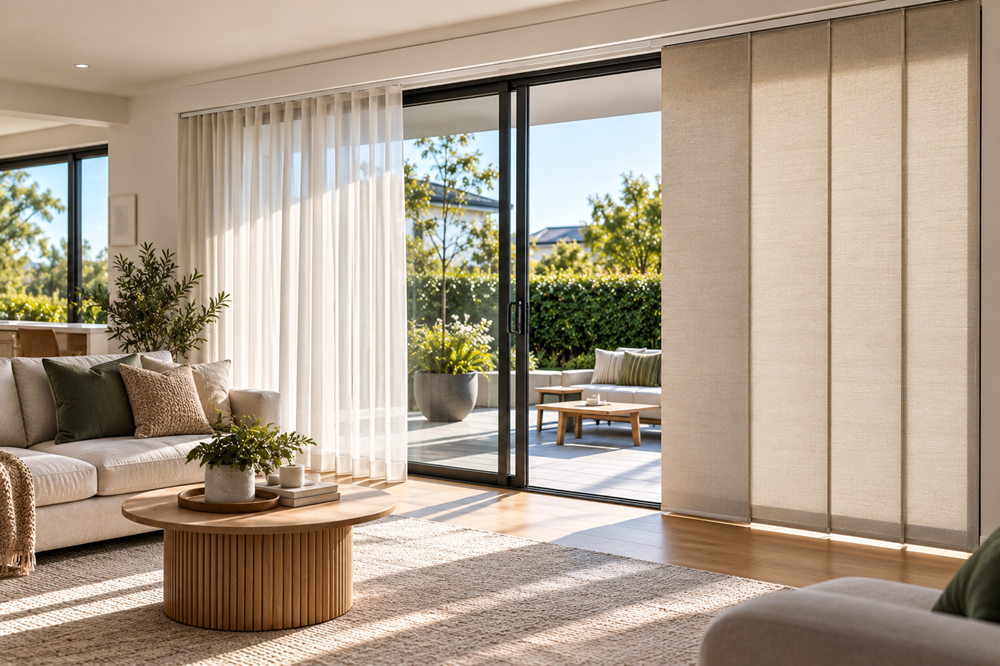
Panel glide blinds are one of the most practical choices for broad glass openings. Instead of numerous narrow sections, the system uses wide fabric panels that move horizontally along a track.
When closed, the panels spread neatly across the glass to provide privacy and light control. When the door needs to be accessed, they slide and stack together, leaving the required section of the doorway open.
This sideways operation works naturally with sliding doors and can create a clean appearance in contemporary living spaces.
Fabric choice can be tailored according to the room. A more opaque material provides increased privacy, while a light-filtering option can maintain a brighter atmosphere during the day.
Before installation, it is important to consider where the panels will stack. Ideally, their position should correspond with the section of the sliding door that is used most frequently. Careful measurement and configuration can make a significant difference to everyday convenience.
Vertical Blinds for Flexible Light Control
Vertical blinds are another established solution for sliding doors, particularly when adjustable light control is important.
Their individual vertical blades can be rotated to alter the amount and direction of incoming sunlight. You can therefore reduce glare without necessarily covering the doorway completely.
When greater access is required, the blades can be drawn sideways along their track. This makes them suitable for frequently used doors connecting living areas with balconies, gardens, patios and alfresco spaces.
Modern fabric choices can also give vertical blinds a cleaner and more contemporary appearance than older versions of this window treatment.
They are particularly useful for large openings because individual blades break up the width of the installation without requiring a heavy single piece of fabric.
For households looking for straightforward operation and the ability to fine-tune privacy throughout the day, vertical blinds remain a practical option.
Roller Blinds for a Clean, Minimal Appearance
Roller blinds can work effectively with sliding doors when the system is carefully planned around the dimensions of the glass.
For particularly wide openings, using multiple blinds rather than one oversized blind can make operation more manageable. Individual blinds can correspond with different sections of the door, allowing you to adjust one area without necessarily covering the entire opening.
Fabric choice then determines how the system performs.
Blockout materials provide stronger privacy and light reduction. Sunscreen fabrics help manage glare while preserving some daytime outward visibility. Translucent materials soften daylight and create greater privacy without making the room feel completely enclosed.
For homeowners wanting something more decorative, lace roller blinds can introduce subtle texture while gently filtering incoming daylight.
The simple profile of roller blinds works especially well in contemporary spaces where the window treatment should remain visually understated.
Correct positioning is essential, however, to ensure handles, frames and frequently used sections of the door remain accessible.
Motorised Blinds for Large Glass Openings
Large window furnishings can require frequent adjustment throughout the day as sunlight moves across the property. Motorised blinds can make this process considerably more convenient.
Instead of manually raising and lowering each blind, suitable motorised systems allow operation through an appropriate control system. This can be particularly useful where several blinds are installed across a broad sliding-door arrangement.
Motorisation can also benefit high or difficult-to-reach installations where manual controls would otherwise be inconvenient.
From a design perspective, removing the need for traditional manual operating components can contribute to a cleaner appearance around the window.
The suitability of motorisation depends on the chosen blind, dimensions of the installation and electrical or system requirements. These details are best considered during the planning stage rather than after the window furnishings have already been selected.
For busy households and contemporary interiors, the added convenience can make managing large glazed areas much easier from day to day.
Roman Blinds for a Softer Interior Style
Although roman blinds are more commonly associated with conventional windows, they may suit certain glazed openings where a softer, fabric-focused appearance is desired.
Roman designs form attractive horizontal folds when raised and create a fuller fabric surface when lowered. This gives them more decorative presence than streamlined roller systems.
They can work particularly well in interiors where the window furnishings are intended to coordinate with upholstered furniture, rugs and other soft finishes.
However, the dimensions and operation of the sliding door need careful consideration. Because the blind raises vertically, adequate clearance is necessary to ensure it does not interfere with frequent movement through the doorway.
For very broad openings or heavily used doors, a horizontally operating solution may sometimes be more convenient. Roman styles are therefore best assessed according to the individual opening rather than assumed to be appropriate for every sliding door.
Sheer Curtains for Soft Light and Elegant Coverage
For homeowners who prefer a softer window treatment, sheer curtains can beautifully complement large sliding doors.
Their flowing fabric works particularly well across broad areas of glass, where full-height curtains can emphasise the height of the room and create a more luxurious finish.
During the day, sheer fabric gently filters strong sunlight while allowing the room to remain naturally bright. This can help soften glare without completely disconnecting the interior from the outdoor view.
They also introduce movement and texture, making them particularly attractive in living rooms, dining areas and open-plan interiors.
For greater flexibility, sheers can be layered with a blockout blind or curtain. The sheer layer can be used during the day, while the secondary covering provides stronger privacy and darkness when required.
When planning curtains around a sliding door, sufficient stacking space should be allowed so the fabric can move away from frequently used sections of the doorway.
Plantation Shutters for a Structured Finish
Plantation shutters provide an architectural alternative to fabric-based window coverings and can be configured for suitable sliding-door openings.
Rather than simply covering the glass with fabric, shutters become a more permanent visual feature within the room. Their adjustable louvres allow occupants to manage privacy, airflow and natural light throughout the day.
For larger doorways, sliding or bi-fold configurations may be considered depending on the available space and how the opening operates.
One advantage is the ability to angle the louvres without necessarily opening the entire shutter. This provides useful control when privacy is required but natural daylight is still welcome.
Their structured appearance works particularly well in homes where clean architectural lines are part of the interior design.
Because sliding-door installations can involve multiple panels and significant dimensions, precise measuring is particularly important. The configuration needs to provide practical access as well as a balanced appearance when both open and closed.
Which Option Is Best for Your Sliding Door?
There is no single window furnishing that is best for every sliding door. The most suitable option depends on the opening and how your household uses it.
Panel glide blinds are particularly effective for large contemporary openings because their broad panels follow the horizontal movement of the door. Vertical blinds provide greater adjustment over the direction of incoming light, while roller systems create a minimal appearance and offer a broad choice of fabrics.
Curtains can introduce softness and provide extensive coverage, whereas shutters offer a more structured architectural finish.
Also consider how often the door is used. A main doorway to a frequently used alfresco area requires easy access, while a secondary sliding door may allow greater flexibility in the type of covering selected.
Sun orientation, privacy, furniture placement and available stacking space should all be considered before making a final decision.
Create a Better Solution for Your Sliding Doors
Sliding doors deserve window furnishings that work with their size and movement rather than making everyday access more difficult. Whether you prefer the clean operation of panel glide or roller systems, adjustable vertical blinds, flowing curtains or the architectural character of shutters, choosing according to the dimensions, sunlight and function of your doorway can produce a much better result. At New World of Blinds, we provide made-to-measure window furnishings designed around individual Melbourne homes and their practical requirements. Our team can help you compare fabrics, configurations and operating options before professionally measuring and fitting your chosen solution. Call New World of Blinds on 0422 786 077 today to arrange a free measure and quote and find the right blinds for your sliding doors.
Frequently Asked Questions
Panel glide and vertical blinds are often practical because they move horizontally and can provide coverage across broad openings. The best option will depend on the dimensions of the door, desired appearance and frequency of use.
Yes. Roller systems can be used across suitable sliding doors. For wide openings, multiple individual blinds may provide easier operation than one very large blind.
Light-filtering, sunscreen and sheer fabrics can provide a balance between daytime privacy and natural brightness. The appropriate material depends on the direction of the window and the level of privacy required.
Yes. Layering can provide additional flexibility. For example, a sunscreen or blockout blind can be paired with curtains to create different levels of light control, privacy and decorative softness.
Custom measurement is particularly valuable for large sliding doors because width, frame configuration, handles and stacking space all influence how the finished window covering will operate.