
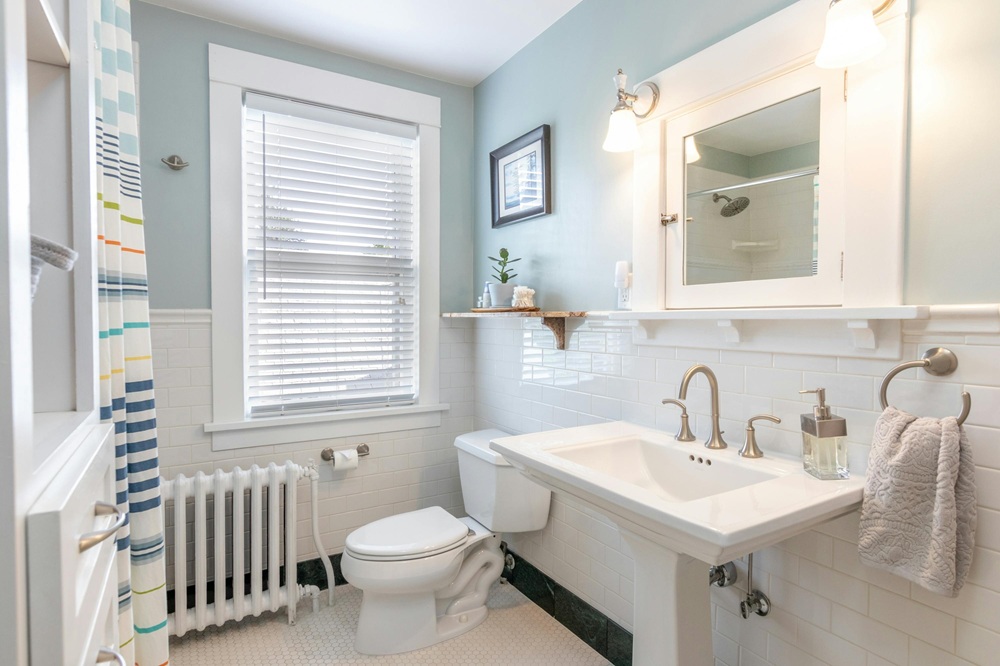
Choosing the right blinds in Melbourne for bathrooms is a decision that goes well beyond aesthetics. Bathrooms are the most moisture-intensive rooms in any home — steam from hot showers, condensation on cold winter mornings, and the occasional splash from the basin all add up to a persistent damp environment that will destroy the wrong blind within a year or two. Melbourne’s variable climate compounds the challenge: the city’s cold, wet winters mean bathroom windows are often the only source of natural light for months at a time, making light control and privacy critical alongside moisture resistance.
Get the choice right and a bathroom blind does serious work: it provides privacy from neighbouring properties, manages natural light through Melbourne’s weather extremes, resists the humidity that builds with every hot shower, and holds its appearance without warping, rusting, or growing mould. Get it wrong and you are replacing the blind within eighteen months. This guide covers everything you need to know to make the right call.
Why Bathroom Windows Demand a Different Approach
The windows in every other room of your home are occasional challenges for window furnishings — direct sun here, a draught there. A bathroom window is a sustained one. Every hot shower fills the room with steam that settles on every surface including the blind. In bathrooms without effective exhaust ventilation — which describes a significant proportion of Melbourne’s established homes — that steam lingers for twenty minutes or more after the shower ends.
Standard blind materials handle this poorly. Timber venetians absorb moisture and begin warping within weeks of regular steam exposure. Fabric roller blinds in standard upholstery-grade material develop mould in the hem, along the bottom bar, and eventually across the face of the fabric. Even aluminium venetians rust at the ladder cords and the headrail if they are not made from the right grade of aluminium with appropriate moisture protection.
The right bathroom blind is built for exactly this environment: non-absorbent materials, corrosion-resistant hardware, and surfaces that can be wiped clean without damage.
Four Factors That Determine the Right Bathroom Blind
Material and Moisture Performance
The material is the first and most important decision. PVC is the highest-performing bathroom blind material in terms of moisture resistance — it is genuinely waterproof, non-porous, and unaffected by steam or condensation. PVC venetian blinds and PVC-coated roller fabrics can be wiped down with a damp cloth, will not develop mould on the surface, and will not warp or swell over time.
Aluminium venetian blinds are the second-best choice for bathroom use. Modern aluminium blinds use corrosion-resistant alloy slats and stainless-steel ladder cords, making them a reliable option for most bathrooms. They are particularly well suited to smaller windows and bathrooms with good mechanical ventilation where steam exposure is brief.
Moisture-resistant coated roller fabrics occupy the middle ground — they handle moderate steam exposure well and are available in a wider range of colours and opacity levels than PVC or aluminium. They are the right choice for bathrooms with adequate ventilation and good airflow. They are not ideal for bathrooms with poor exhaust or windows that are regularly exposed to direct water splash.
2. Privacy Requirements
Bathroom windows present a specific privacy challenge: they need to be covered even when open for ventilation. A blind that cannot be partially raised without exposing the interior is a blind that stays permanently closed — eliminating the natural light and ventilation the window is there to provide.
Venetian blinds handle this best. The slats can be tilted to allow airflow and diffused light while maintaining visual privacy from any angle outside. A roller blind in a translucent fabric provides privacy without completely blocking light when fully drawn, but offers no ventilation function.
For bathrooms on the ground floor with close neighbouring properties — common in Melbourne’s inner-northern and inner-western suburbs — privacy is non-negotiable and a top-down-bottom-up roller system, or a venetian with precise slat control, is worth the additional investment.
3. Light Control
Melbourne’s seasonal light variation is more pronounced than most Australian cities. Winter mornings are dark; summer mornings are bright well before 6am in the outer suburbs. A bathroom blind needs to manage both extremes in the same room.
A translucent or day-night roller blind provides soft natural light through winter without full exposure. A venetian with adjustable slats handles both — tilted partially open in winter to maximise the available light, and closed against early summer sun. For ensuites attached to bedrooms where morning light is a sleep quality concern, a blockout roller blind may be appropriate even in a wet area.
4. Ease of Cleaning
A bathroom blind accumulates soap residue, mineral deposits from hard water, and the surface grime that settles in any high-use room. The material needs to wipe clean without requiring removal or specialist treatment.
PVC venetians and aluminium venetians can be wiped slat by slat with a damp cloth. PVC-coated roller fabrics wipe clean along the surface. Fabric roller blinds in standard materials need to be spot-cleaned carefully and dried promptly to prevent mould development. Any blind with a fabric bottom bar hem is more difficult to clean and dry than one with an aluminium or PVC bottom bar.
The Best Blind Types for Melbourne Bathrooms
PVC Venetian Blinds
PVC venetians are our most recommended bathroom blind for Melbourne homes with moderate to poor bathroom ventilation. The slats are completely waterproof, wipe clean easily, and provide the precise light and airflow control that bathroom windows need. They are available in a wide range of colours and in 25mm, 50mm, and 63mm slat widths — narrower slats suit smaller windows and a more contemporary aesthetic; wider slats suit larger windows and a bolder look.
Aluminium Venetian Blinds
Aluminium venetians are excellent for bathrooms with good exhaust ventilation — ensuite bathrooms that are used briefly and well-ventilated, or powder rooms without a shower. The aluminium slats are durable, lightweight, and available in a wider range of anodised colours and finishes than PVC. They are not recommended for bathrooms where steam lingers for extended periods, as ladder cord and headrail corrosion can become an issue over time in high-humidity environments.
Moisture-Resistant Roller Blinds
Moisture-resistant roller blinds in PVC-coated or specially treated fabrics are a strong choice for bathrooms with reliable exhaust ventilation. They offer the widest range of colours, opacity levels, and fabric textures of any bathroom blind option — from near-sheer translucent fabrics that maximise natural light to full blockout for ensuite privacy. The wipe-clean surface handles moderate steam exposure well, and the slim-profile cassette housing suits contemporary bathroom renovations where the window space is limited.
What to Avoid
Three materials are consistently problematic in Melbourne bathrooms: natural timber venetians (warp and mould regardless of sealant), standard fabric roller blinds in non-treated upholstery-grade material (mould develops in the hem and fabric surface), and Roman blinds in any fabric (the folds trap moisture and the fabric cannot be wiped clean). These are appropriate in every other room of the house. They are not appropriate in the bathroom.
Getting the Measurement and Fit Right
A bathroom blind that gaps at the sides or sits loose in the frame is a privacy failure on its primary function. Precise measurement is not optional — it is the single most important factor in whether a bathroom blind actually works.
Inside-mounted blinds sit within the window recess and require a precise width measurement to the millimetre to avoid light gaps at the sides. Outside-mounted blinds sit over the window frame on the surrounding wall, providing better edge coverage and a larger apparent window size. In bathrooms with deep window reveals, inside mounting is usually the cleaner result. In bathrooms where the window frame is shallow or the wall space around the window is accessible, outside mounting provides better privacy coverage.
Professional measurement is worth it for bathroom windows specifically because the consequences of an imprecise fit are visible and functional, not just aesthetic.
Melbourne-Specific Considerations
Melbourne’s cold winters create condensation patterns on bathroom windows that do not occur in warmer cities. Cold single-glazed glass in an unheated bathroom produces condensation on both the glass and the blind during winter mornings. This condensation runs down the blind surface and collects in the hem or at the bottom bar — and in a fabric blind, this daily moisture accumulation is a reliable mould pathway.
For Melbourne’s established homes with original single-glazed bathroom windows, the recommendation is always a fully waterproof material — PVC venetian or PVC-coated roller — precisely because of this condensation pattern. Modern homes with double-glazed windows and mechanical exhaust ventilation have more material options, but the moisture-first approach remains the safest starting point.
New World of Blinds — Custom Bathroom Blinds Across Melbourne
New World of Blinds has been manufacturing and installing custom bathroom blinds for Melbourne homes since 2005. We make every blind at our Campbellfield facility using moisture-appropriate materials, measure every window ourselves, and install with our own team backed by a 5-year warranty. Whether you need PVC venetians for a poorly-ventilated original bathroom, aluminium venetians for a modern ensuite, or moisture-resistant roller blinds for a contemporary renovation, we will advise on the right material and fit for your specific window and bathroom conditions.
Call us on 0422 786 077 to book a free in-home measure and quote. We visit your home, assess your bathroom windows, show you material and colour options, and provide a written itemised quote at no charge.
Frequently Asked Questions
PVC is the best material for poorly-ventilated bathrooms. PVC venetian blinds and PVC-coated roller fabrics are completely waterproof, do not absorb moisture, and can be wiped clean without the risk of mould developing in the fabric. Melbourne’s cold winters add a condensation challenge on single-glazed windows that makes a non-porous material essential for bathrooms that are not well-ventilated.
No — timber venetian blinds are not suitable for bathroom use. Even sealed timber absorbs moisture from steam and condensation over time, causing the slats to warp and swell, the finish to lift, and mould to develop in the joints and cord holes. Aluminium or PVC venetians are the correct choice for bathroom windows.
Yes, provided the fabric is specifically rated for moisture resistance. Standard roller blind fabrics used in living rooms and bedrooms are not suitable for bathroom windows — they absorb steam, develop mould in the hem, and deteriorate quickly. Moisture-resistant or PVC-coated roller fabrics handle bathroom conditions well in rooms with adequate exhaust ventilation. For bathrooms with limited ventilation, a PVC venetian is a more reliable choice.
Precise measurement is critical for bathroom blinds because a gap at the side of the blind creates a privacy failure as much as a fitting issue. Inside-mounted blinds in particular need to be cut to the millimetre to avoid light and view gaps at the sides of the window recess. Professional measurement also ensures the mounting hardware suits the window frame material and that the blind sits correctly in both the open and closed positions.
Yes. New World of Blinds provides a 5-year warranty on all bathroom blinds supplied and installed by our team, covering both the product and the installation workmanship. If anything is not right within five years — a material defect, a hardware fault, or an installation issue — we return and rectify it at no cost. Call 0422 786 077 to discuss your bathroom blind requirements.